AI Use Cases in Mining: Where Paperwork Earns Its Keep First
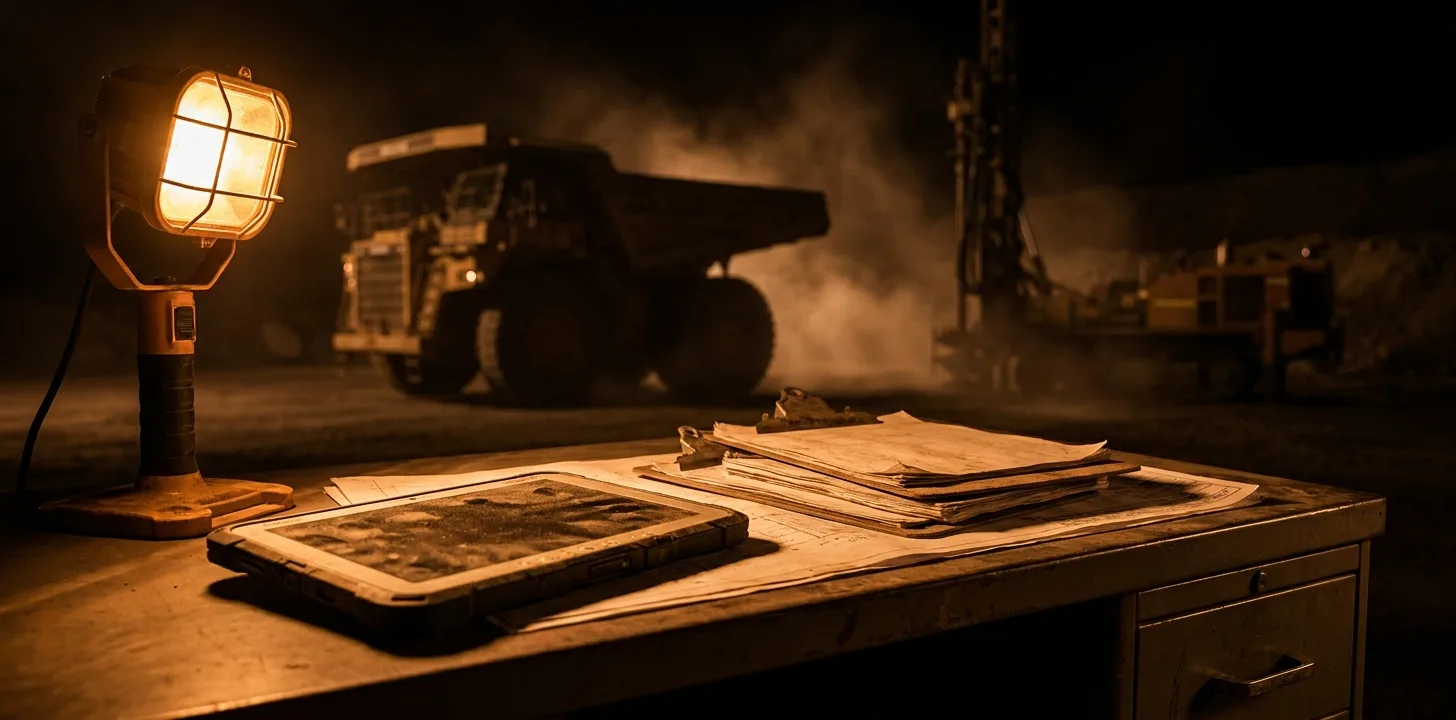
The conversation about AI in mining jumps to autonomous haulage trucks inside 30 seconds. Those trucks exist. They also require dedicated haul roads, capital budgets above most contractors' total revenue, and years of commissioning. If you run a drill-and-blast or hard-rock development crew, that conversation is not about your business yet.
What is about your business: the paper. Daily production reports, shift logs, MSHA injury records, equipment hours, invoice reconciliation. A 4-crew contractor generates 88 of these documents in a working month. Most of the numbers in them get entered at least twice before an invoice leaves the office. That is where AI earns its keep today, not at the bench.
This post goes through the ai use cases in mining that apply to a contracting operation right now. Use case by use case, with the autonomous equipment picture honest and in proportion.
Worked example
A surface drill-and-blast contractor running 4 blast crews across 2 open-cut sites. Each crew submits a daily production sheet: metres drilled, explosive weight, equipment hours, and any delays. The office manager consolidates these into a weekly owner's summary and a monthly client invoice. Assume 15 minutes per report for reading, pulling the key numbers, and entering them into the next format.
| Step | Calculation | Result |
|---|---|---|
| Reports generated in one month | 4 crews x 22 working days = 88 reports | 88 reports/month |
| Office time to process all reports | 88 reports x 15 minutes = 1,320 minutes = 22 hours | 22 hours/month |
| Annual office time on report consolidation | 22 hours/month x 12 months = 264 hours/year | 264 hours/year |
| Equivalent in working weeks | 264 hours / 40 hours per week = 6.6 weeks | 6.6 working weeks/year |
Answer: On these inputs, a 4-crew contractor spends 264 hours a year moving numbers from daily production sheets into summaries and invoices: 6.6 working weeks on a task that produces no new information. That is the exposure. What the system cuts is the retyping, not the review.
What the Office Actually Generates
Every shift, something goes on paper or into a phone. Metres drilled, explosives used, hours clocked, equipment faults, headcounts, safety observations. That is the raw material of a contracting business.
By the time the weekly owner's summary is due, the same numbers have been entered at least twice. Once by the crew or supervisor. Again by the office to produce the client report. On a cost-plus contract, often a third time when someone needs to support the invoice line by line.
That repeated entry is not carelessness. It is what happens when the systems do not talk to each other. The crew uses WhatsApp or a paper form. The supervisor uses a spreadsheet. The invoicing system is something separate. Each step requires a person to read the last format and produce the next one.
This is the layer where language models are useful today. Not because they understand rock mechanics or blast design. Because they can read a document faster than a person can retype it, and they flag when something does not add up.
Reading the Daily Report
A current language model can take a PDF or a photo of a handwritten daily production sheet and extract the structured fields. Date, crew, site, metres drilled, machine hours, consumables. That output populates a spreadsheet row directly, without a person reading the sheet and typing each field.
This is the same technology that reads a fuel receipt in an expense app and populates the amount and vendor. What is different in a mining context is that the documents are more complex, the field names vary by contract, and an error in a metres figure has downstream consequences for the invoice and the client report.
At 4 crews running standard daily reports, the consolidation work alone runs to 264 hours a year. That is 6.6 working weeks applied to a task that moves numbers from one format to another, with no new information created in the process.
The practical workflow: a supervisor photographs the daily sheet and sends it to a shared inbox. The model reads it, extracts the fields, and loads a draft row into the weekly summary. The office manager opens the summary each morning, reviews the new rows, and approves the batch. If a field is missing or a number does not reconcile with the previous day, the system flags it rather than carrying the gap forward.
The model makes mistakes. Handwriting varies. Field names change between sites and between contracts. A blank field where the rig was down for maintenance looks identical to a blank field where someone forgot to write the number. Both produce a flagged gap. The difference is that the gap is visible and assigned for a person to resolve before it becomes an invoice discrepancy.
The ratio of clean rows to flagged exceptions is something you measure in your own operation after the first month. No system-agnostic number applies, because it depends on how variable your forms are and how consistent your crew handwriting is.
MSHA Record-Keeping and Part 50
Mining contractors have specific reporting obligations under 30 CFR Part 50. Accident, injury, and illness reports must be filed within fixed timeframes and must contain specific fields: contractor ID, mine identification, nature of injury, days away from work, and root cause. These fields are defined. They do not change based on which site you are working or what the client calls the job.
Pattern-matching against a defined field set is exactly where language models perform well. A model reading a safety observation from the shift log can check whether it contains the fields required for a Part 50 report. It can flag the entries that might need filing and draft an initial record for the safety manager to review. The safety manager still makes the judgment call on whether an event is reportable. The model does not.
What this workflow prevents is the gap-and-scramble: an event happens on Wednesday, the paperwork sits in an inbox, and on Friday someone realizes the 10-working-day filing window is closing. A system that reads the daily safety log and flags potential reportable events moves that check to the shift level rather than the end of the month.
This is not about replacing the safety manager's judgment. It is about making sure the information reaches the safety manager before the deadline does.
Invoice Reconciliation on Cost-Plus Contracts
The monthly invoice on a cost-plus contract is built from the production records. Metres drilled, explosive weight used, hours charged by equipment class, consumables. If the daily records are clean and reconciled, building the invoice is arithmetic. If they are not, the office spends part of every invoice cycle tracking down discrepancies.
An AI step in this workflow runs the reconciliation automatically. It takes the month's production rows and compares them against the contract rate codes. Any line that does not match an approved code or is missing supporting documentation gets flagged. The owner or office manager reviews the flagged lines. If everything reconciles, the review is fast. If something does not, the system has already named the line and the gap.
The audit trail matters when the client questions an invoice. A cost-plus invoice built from manually entered data supports itself with whatever documentation someone thought to keep. An invoice built from parsed source documents and checked against rate codes is auditable back to the original field record. No search through email and WhatsApp history required.
What the Autonomous Equipment Picture Actually Looks Like
Komatsu's FrontRunner autonomous haulage system has been running in production since 1997 at Codelco's Gabriela Mistral mine in Chile. Rio Tinto's West Angelas mine in Western Australia added five trucks in late 2008 (SME Mining Engineering Handbook, 3rd edition, 9.8.2.2 Autonomous Surface Dump Trucks, p. 808). Both sites use 930E-4 electric-drive trucks with a 300-tonne payload, on dedicated haul roads not shared with manually driven vehicles.
This is real technology operating in real mines. It is also technology at a scale that belongs to major producers running dedicated greenfield projects. A drilling or development contractor working across existing sites does not control the haul roads, the truck fleet, or the commissioning decision.
Automated digging is further out. The Handbook projects the transition to autonomous diggers over the next 20 years (9.8.2.7.1 Capabilities of the Autonomous Digger, p. 811). The path is incremental: stepping-stone technologies that let risks be understood and controlled at each stage before the next step is attempted.
Automated drill rigs for blasthole drilling exist today. Sensor failure on the drill is a common problem that can stop the whole system. High-precision GPS is difficult in deep pits. Detection of worn bits or drill-string failure can be difficult (9.8.5.5 Challenges to Overcome, p. 822).
The ai use cases in mining that will matter most in 10 to 20 years at the major producer level are real and worth knowing. They are not where a contracting business starts, and they are not decisions a contractor controls.
Where It Does Not Make Sense
A vendor who names where his own system does not apply is the only kind this buyer has not met before. Here is where AI adds no value in a contracting operation.
Underground workings with no wireless coverage are outside any real-time system. A report written on paper and handed to the surface supervisor can still be parsed once it reaches the office. Live monitoring requires live data, and live data requires connectivity that many underground headings do not have.
Equipment decisions in variable geology require judgment built from experience in specific ground. A model that has read three months of production reports has no feel for what the drill responds like in a contact zone. It can summarize the records. It cannot replace the shift boss at the face.
Anything where the expertise has never been written down is not a candidate. If the knowledge lives in what an operator feels through the controls rather than in any document, AI cannot access it or replicate it.
The useful question for any task in your own operation: does completing this task require reading information that is already written down? If yes, it is a candidate. If the task depends on knowledge that exists only in people's heads and hands, it is not.
The Data Question, Answered Honestly
The question contractors ask once they understand what the system does: what happens to my data?
The honest answer is that the model trains on your data. That is how it learns your codes, your rate structures, your exceptions, your crews' shorthand on the daily sheets. That learning is specific to your operation. It is not pooled with any other contractor's data.
Start with one contract on one site for one month. Redact whatever makes you uncomfortable before you send anything. The NDA is signed before anything is seen. If the output is not useful at the end of that month, you stop and nothing has changed.
Your data already lives in the cloud. Your email, your accounting software, the photos in the WhatsApp group your supervisors use. What changes is that something can finally read it and give you a consistent answer from it.
The question worth asking carefully is which system holds the data and under what terms. That question has a real answer for any legitimate vendor. "Nothing trains on your data" does not: it is what every vendor says, and only one of them can be telling the truth.
Common questions
My rates and my contracts are the business. My client's information is all over my dailies. Why would I hand any of it over?
Start with one contract, not the whole company. Redact whatever makes you uncomfortable before you send anything. The NDA is signed before anything is seen. Yes, it trains on your data: that is the point. It is learning your codes, your rates, your handwriting, your exceptions. That learning is yours and it is never pooled with anyone else's.
AI hallucinates. I cannot have it making up metres.
The numbers are not generated: they are read from the document you sent and reconciled against the previous entry. When a field is missing or does not reconcile, the system flags it for a person to check. Nothing goes to an invoice without a human sign-off. The model surfaces gaps; a person closes them.
Does a person still check it?
Yes. The output of the AI step is a draft: the numbers it read, the discrepancies it flagged, and the fields it could not fill. The office manager reviews that draft and approves it before anything moves forward. The AI removes the retyping; it does not remove the check.
Where does AI not make sense in my operation?
Underground workings with no wireless coverage. Equipment decisions in ground conditions the model has not seen before. Anything where the judgment call depends on what a shift boss smells or hears. AI reads documents well. It does not replace the person with a lamp and muddy boots, and it is not designed to.
Getting this off paper
Most contractors already know these numbers. The cost is in re-keying them into a report, then a timesheet, then an invoice. If that is where your week goes, book a twenty minute call and we will look at your actual paperwork.