Underground Jumbo Development
Metres of advance per shift, per day and per month from the round you drill and
the jumbo that drills it, plus what a metre of heading costs you.
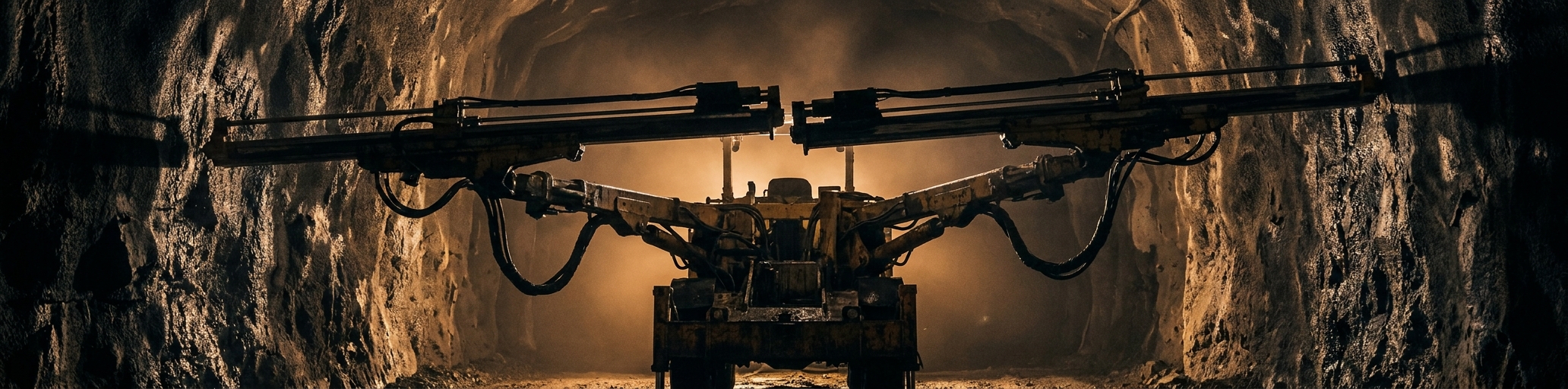
Underground development headings only — a twin-boom drill jumbo advancing a
drift, crosscut, ramp or decline by drill and blast. It is not a bench drilling tool, not a
continuous miner or roadheader model, not a ground-support design, and not a ventilation design.
It sizes the jumbo's share of the cycle only: mucking, charging, blasting, re-entry and
the rest of the ground support happen on other machines and are not in these numbers.
Step 1 — The heading
Everything downstream is per metre of this profile.
Step 2 — The round
Hole depth and pull set your advance. Nothing else in this tool moves it.
Step 3 — The jumbo cycle
Setup, drilling and support. What one face costs the machine in hours.
Step 4 — The shift
The gap between the cycle and the shift is where development schedules die.
Delays, as recorded on shift reports. These are the eight the source measured.
Step 5 — Your costs
These are yours, not the handbook's. The source is explicit that development cost is too site-specific to publish as a rate.
Step 6 — Benchmark it
A published all-in band to sanity-check what you just built up.
| Step | Value | Where it comes from |
|---|
The round, drawn
Where the shift goes
Rock density, if you do not know yours
| Rock | Bank density, t/m³ | lb/yd³ |
|---|
SME Mining Engineering Handbook, Table 10.4-1, p. 933, after Atkinson 1992. Bank density is the rock as it sits in the ground, before it is blasted and swells, which is the same thing Table 12.2-1 calls rock density (wet) and the right number for this page. Pick the closest rock in Step 1 and it fills itself in. This table publishes every density twice, in tonnes per cubic metre and pounds per cubic yard, and the two agree across all 37 rows to within 1.7%, the gap being the book rounding the pounds column to the nearest hundred. The printed page also carries swell, fillability and digability columns; they describe loading the broken rock rather than drilling it, so they are deliberately not reproduced here.
What a jumbo drills, and how fast
| Drilling method | Diameter, mm | Typical depth, m | Rate, m/min | Rate, m/h | Accuracy, cm/m |
|---|
SME Mining Engineering Handbook, Table 7.2-1, p. 439. The metres per minute column is converted from the printed metres per hour, because m/min is the unit Table 12.2-2 states penetration rate in. The printed footnote is what makes these numbers mean the same thing as the field in Step 3: "drilling rates are for actual drilling and do not include time for drill retraction, boom relocation, collaring, etc. Drilling rates decrease as rock mass strength increases and may increase or decrease depending on the number and orientation of joints/blocks." This page counts boom relocation and collaring separately, as boom setup per hole, so do not fold them into the rate as well or you pay for them twice. The surface crawler and down-the-hole rows on the printed page are for bench drilling and are left out. Note that the worked example drills a 3.05 m round, shorter than the 4 m these rows quote as typical.
The published example, table by table
| Physical development parameter | Measurement |
|---|
SME Mining Engineering Handbook, Table 12.2-1, p. 1153. Loading this page reproduces every row of it. The printed overbreak is 5%, not the 5.6% our first transcription carried: 22.5 m² × 2.8 t/m³ × 1.05 gives the printed 66.2 t/m exactly, and 5.6% does not. Read off the printed page and corrected.
| Jumbo cycle component | Measurement |
|---|
SME Mining Engineering Handbook, Table 12.2-2, p. 1154. Two rows here are printed values this tool does not reproduce and does not use: drill metres per engine hour, and average penetration rate per boom. Neither follows from the other cells on the page — the boom rate comes out at 0.93 m/min on every route through the table we could find, against a printed 0.71 — so they are shown as published and left out of the chain rather than having a derivation invented for them.
| Development performance component | Measurement |
|---|
SME Mining Engineering Handbook, Table 12.2-3, p. 1154. Measured at a mine where every jumbo had at least five faces available to it, so it was never waiting on a muck cycle.
Published all-in development costs
| Development item | Dimensions | $/m | $/ft |
|---|
SME Mining Engineering Handbook, Table 12.5-1, p. 1220, in 2009 US dollars at ±25%, for fairly fractured and weathered ground in central Nevada requiring regular bolting with split sets on 1.2 m centres. This table publishes every rate twice, in dollars per metre and dollars per foot, and the two agree to better than 1% on all six rows above, which is an independent check that a transcription cannot pass by accident. The seventh printed row, for pump stations and shops, is deliberately not carried here: it is quoted per unit of volume, and the book's own metric column converts it with the linear foot-to-metre factor instead of the cubic one, making it roughly eleven times too small.
What a heading actually achieves
| Situation | Advance | Source |
|---|
All from the SME Mining Engineering Handbook, p. 1153. The single-heading numbers are the ones to hold this tool against. A model built on five available faces describes a jumbo that never waits; a decline being driven off one face is a different machine doing a different job.
Spending more time on spreadsheets than on the job?
We build the reporting and admin automation for mining contractors, so the numbers keep themselves.
Book a 20 min callTerms of use and disclaimer
Estimating aid only. This calculator is an educational tool. It is not an engineering design and it is not a substitute for the judgment of a competent or qualified person.
No warranty. It is provided "as is", without warranty of any kind, express or implied, including any implied warranty of merchantability or fitness for a particular purpose. Equations and constants are cited to their published sources above, but transcription, implementation and the values you enter can all be wrong. Verify every result against the cited source and against your own site conditions before it informs a decision.
Not a statutory document. Nothing produced here is a ground control plan, ventilation plan, blast design, haul road design or hoist design. Those must be prepared, signed and approved under the regulations that apply to your operation. Compliance with MSHA, or with your own jurisdiction's mining regulations, is the operator's responsibility and remains so.
Assumption of risk. You use this tool entirely at your own risk. Mining is hazardous, and errors in ground support, ventilation, blasting or haulage can cause serious injury or death.
Limitation of liability. To the maximum extent permitted by law, Big Dog Mining and its owners, operators and contributors accept no liability for any loss, damage, injury, death, cost or claim, whether direct, indirect, incidental or consequential, arising out of or in connection with the use of this tool or reliance on its output.
Indemnity. By using this calculator you agree to indemnify and hold harmless Big Dog Mining and its owners, operators and contributors against any claim, demand, loss, liability or expense, including reasonable legal fees, arising from your use of it or from any decision taken in reliance on it.
If you do not accept these terms, do not use this calculator.