Underground Pillar Design
What the pillars are carrying, what they can carry, and the ratio between
the two — plus what you give up in recovery to get it.
Underground room-and-pillar layouts only — a regular array of pillars on
one horizon. It is not a barrier pillar or panel design, it does not model abutment loading from
an adjacent gob, it is not a numerical stress model, and it says nothing about the back between
the pillars. Bolts hold the back up; this page is about what holds the mine up. A competent
person signs the layout.
Step 1 — The layout
Pillar width against room span decides both the load and the recovery.
Step 2 — Depth and stress
In-situ vertical stress is just the weight of what is above you.
Step 3 — Pillar strength
Eight published formulas, and they do not agree. Pick deliberately.
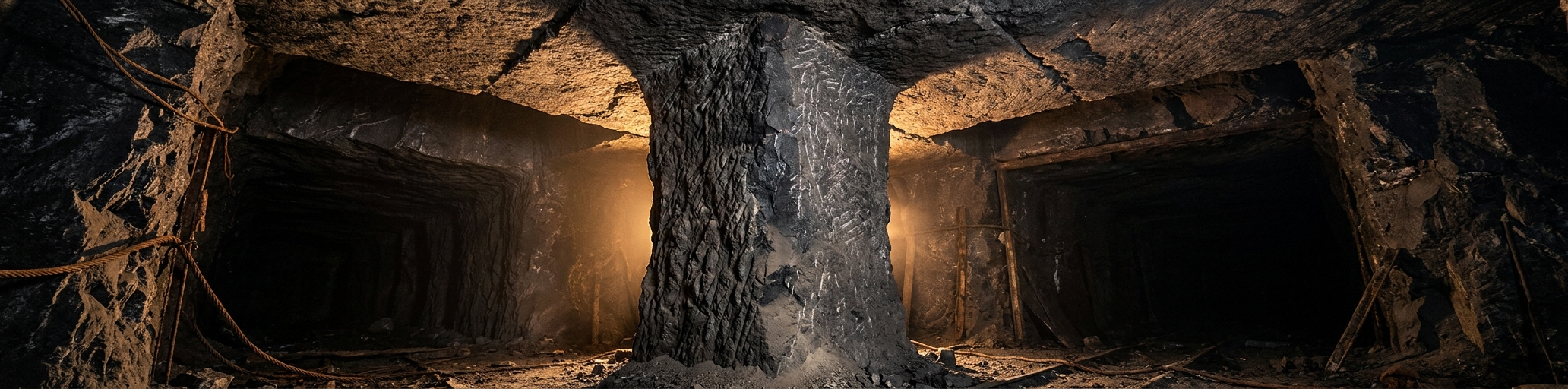
Step 4 — What the pillars look like
A number is a prediction. This is an observation, and it outranks the number.
| Step | Value | Where it comes from |
|---|
The layout, and what each pillar carries
Factor of safety against pillar width
The eight published strength formulas
| Source | a | b | α | β | Fitted to |
|---|
SME Mining Engineering Handbook, Table 13.1-1, p. 1329,
after Zipf 2001. Two general forms are printed with it:
σP = σS(a + b·W/H) (Eq. 13.1-12) and
σP = K·Wα/Hβ
(Eq. 13.1-13). Obert-Duvall and Bieniawski follow the first; Salamon-Munro and Holland follow
the second.
The daggers are not decoration. Three of the power-law formulas are printed
“use with English units only” and one “use with metric units only”.
A power law is not dimensionless, so running one in the wrong system does not scale — it
gives a different answer with no sign that anything happened. This page refuses rather than
converts.
A conflict worth knowing about. Rock Mechanics for Underground Mining
p. 379 gives Salamon and Munro as α = −0.66, β = 0.46 — the same two
numbers as the table above, with the letters swapped and a sign changed, because it writes the
formula in a different form. Take α from one book and β from the other and the
exponents land on the wrong variables. This page uses the SME convention throughout.
Rating a pillar by looking at it
| Rating | Condition |
|---|
SME Mining Engineering Handbook, p. 1331, after Carmack et al. 2001. Hourglassing is the shape a pillar takes when the walls have spalled away and the load has migrated to a smaller core, which is a late stage and not a warning.
Published pillar widths by depth and mining height
| Depth of cover, m |
|---|
SME Mining Engineering Handbook, p. 1028, adapted from Vandergrift et al. 2004. Read down for depth of cover and across for mining height; the cell is a pillar width in feet. Mining heights run 0.9 to 2.7 m, so this is a COAL table and it is here as a sanity check on the shape of an answer rather than as a design for a hard-rock heading. The blanks are blank on the printed page: not every depth and height combination is covered, and this page does not interpolate into them.
Spending more time on spreadsheets than on the job?
We build the reporting and admin automation for mining contractors, so the numbers keep themselves.
Book a 20 min callTerms of use and disclaimer
Estimating aid only. This calculator is an educational tool. It is not an engineering design and it is not a substitute for the judgment of a competent or qualified person.
No warranty. It is provided "as is", without warranty of any kind, express or implied, including any implied warranty of merchantability or fitness for a particular purpose. Equations and constants are cited to their published sources above, but transcription, implementation and the values you enter can all be wrong. Verify every result against the cited source and against your own site conditions before it informs a decision.
Not a statutory document. Nothing produced here is a ground control plan, ventilation plan, blast design, haul road design or hoist design. Those must be prepared, signed and approved under the regulations that apply to your operation. Compliance with MSHA, or with your own jurisdiction's mining regulations, is the operator's responsibility and remains so.
Assumption of risk. You use this tool entirely at your own risk. Mining is hazardous, and errors in ground support, ventilation, blasting or haulage can cause serious injury or death.
Limitation of liability. To the maximum extent permitted by law, Big Dog Mining and its owners, operators and contributors accept no liability for any loss, damage, injury, death, cost or claim, whether direct, indirect, incidental or consequential, arising out of or in connection with the use of this tool or reliance on its output.
Indemnity. By using this calculator you agree to indemnify and hold harmless Big Dog Mining and its owners, operators and contributors against any claim, demand, loss, liability or expense, including reasonable legal fees, arising from your use of it or from any decision taken in reliance on it.
If you do not accept these terms, do not use this calculator.